Showing posts with label books. Show all posts

Saturday, January 04, 2014

Sleep Teaching

Last year I read Bringing Up Bébé by Pamela Druckerman, and I loved it. She presents a different way of viewing parents, children, and their relationship from the typical American view. Her writing is engaging and entertaining. It is full of good advice, but it doesn't read as a self-help book. Rather she tells the story of her own parenting and shares research she gathered from French books and parents and American books and parents. She never places commands on how to raise children: this is so refreshing compared to other American books and magazines on parenting which seem to love spurting commands.

I made a mental note to re-read the bits on sleep before my next child.  I've only two more months before I can practice what I've read here, but I still feel like I'll forget the main points, so I wrote them all down.  Here I sum up the key points from her chapter "Doing Her Nights."

Of course with this list you miss out on Druckerman's wherefores and hows and examples, and her engaging writing. So consider this as a refresher course for those who read the book.  Or perhaps it will whet the appetites of others to read her book.  


  • Believe a baby is a person who is capable of learning things and coping with frustration. Frustration is good for babies – it makes children more secure. 
  • It is good for parents and babies when they sleep through the night, and they can do this from 2-4 months of age. 
  • Babies need to be by themselves. Babies who learn to play by themselves in the day will be more content in the crib alone at night. Consider that babies need privacy – times when they are awake without any needs and all alone. 
  • Place value on the parents' quality of life and not just the child's welfare. 
  • It's the parents' job to teach babies to sleep well. Teaching a baby to sleep is a first lesson on self-reliance and enjoying one's own company. 
  • The one most crucial thing is to do "le pause" – wait when your baby starts crying. Give them a chance to self-soothe. Observe them first. When babies cry, they are telling us something – listen to figure it out. 
  • Babies make lots of noise in their sleep – they may be moving, but they are still sleeping. Don't think of these movements or noises as a call to you. 
  • Babies wake up between their sleep cycles (about every 2 hrs) and they must learn to connect these sleep cycles on their own. They can learn this between two and three months old. Intervening between cycles leads to sleep problems. 
  • Teach babies the difference between night and day by refraining from holding, rocking, nursing the baby to sleep in the evenings. 
  • Between midnight and 5am, re-swaddle, pat, re-diaper, walk… Only if the baby continues crying should you nurse. 
  • If you miss the 4-mo window for "sleep teaching," you must do "sleep training" – having the baby cry-it-out. Either go "cold turkey" or take it in stages, and it will succeed in a few days. As you do this, explain to the child what you're about to do. Consistency is key. 

Saturday, February 11, 2012

parenting

Despite the annoyingly-catch-your-eye-title, this article was good:
I'd recommend reading it, and watching the video in the middle of it that expands on the ideas, if you're into that sort of thing.....  

En bref: it's written by an American mom living in France, who noticed that French children did not act like American children. She began to study the differences, find that other such studies had been done, and she wrote a book.  I think it'd be an interesting read.

I'll highlight the differences.  The French parents view themselves as authorities. {Crazy concept, no?  Apparently American parents do not.} They see their role as establishing a frame with firm boundaries where their children have freedom within.  French parents place a higher value [than American parents] on
- teaching delayed gratification  (learning to wait, patience, etc...)
- independent play (connected to...)
- adult time
- trying all kinds of food
I'm sure the book has more.  She wrote nicely, and I think it would be an éclairante et agréable read.

The ideas aren't revolutionary, and I think they follow biblical values.  But perhaps the majority of American parents won't accept these values on the basis of them being "Christian", but would be willing to try them as "French"?  Hmmm.

Friday, June 24, 2011

summer reading

I've taken to a flurry of pregnancy reading.

I started out reading online about weekly developments of our baby on various websites. I particularly like:
When Carol came to visit, she brought a few books from Ruth.
  • Vicki Iovine's The Girlfriends' Guide to Pregnancy. This is an entertaining read written from the perspective of your girlfriend. It's not a doctor's guide, and it's not full of so many statistics. But it explains all sorts of unusual feelings and behavior of pregnant women, and warns the reader about lesser-known side effects and things to be prepared for. It's got laugh-out-loud passages and lots of good advice.
  • The Little Big Book of Pregnancy, which is one of those coffee table books with quotes and short stories and photos to inspire and encourage pregnant women...
Garrett's mother sent us a care package with a book that was my sister-in-law's favorite:
  • Tracy Hogg's The Secrets of the Baby Whisperer. This book was written by a British woman in the 90s who was a ...and lactation specialist. She was a bit opinionated, but I liked her philosophy a lot and will probably try to adopt it. She included lots of good guides that I am sure I will reference when our little one is born.
An English library in Prague had a used book sale recently, and I picked up a whole bunch of other books:
  • The New Mother's Guide to Breastfeeding: I just finished this last night. It rather smacks of propaganda from the American Academy of Pediatrics, but specific instructions were helpful, and I'm glad I got it.
  • Babywise: I haven't started it yet, but it appears to be about training your child to sleep through the night.
  • Babywise, Book Two: Parenting Your Pretoddler, Five to Fifteen Months
  • Burton White's The New First Three Years of Life
And finally, my sister Elizabeth just lent me:
  • What to Expect the First Year

Saturday, November 20, 2010

treasure

This is delightful:
When I was six or seven years old, growing up in Pittsburgh, I used to take a precious penny of my own and hide it for someone else to find. It was a curious compulsion; sadly, I've never been seized by it since. For some reason I always "hid" the penny along the same stretch of sidewalk up the street. I would cradle it at the roots of a sycamore, say, or in a hole left by a chipped-off piece of sidewalk. Then I would take a piece of chalk, and, starting at either end of the block, draw huge arrows leading up to the penny from both directions. After I learned to write I labeled the arrows: SURPRISE AHEAD or MONEY THIS WAY. I was greatly excited, during all this arrow-drawing, at the thought of the first lucky passer-by who would receive in this way, regardless of merit, a free gift from the universe. But I never lurked about. I would go straight home and not give the matter another thought, until, some months later, I would be gripped again by the impulse to hide another penny.
- Pilgrim at Tinker Creek, chapter 2
And then she goes on about nature and seeing, linking it back to this story in metaphorical tones. I want everything she writes to be true.

I hope it is.

Sunday, October 31, 2010

Annie Dillard again

Here is an excellent snippet from Pilgrim at Tinker Creek:

At the end of the island I noticed a small green frog. He was exactly half in and half out of the water, looking like a schematic diagram of an amphibian, and he didn't jump.

He didn't jump; I crept closer. At last I knelt on the island's winter killed grass, lost, dumbstruck, staring at the frog in the creek just four feet away. He was a very small frog with wide, dull eyes. And just as I looked at him, he slowly crumpled and began to sag. The spirit vanished from his eyes as if snuffed. His skin emptied and drooped; his very skull seemed to collapse and settle like a kicked tent. He was shrinking before my eyes like a deflating football. I watched the taut, glistening skin on his shoulders ruck, and rumple, and fall. Soon, part of his skin, formless as a pricked ballon, lay in floating folds like bright scum on top of the water: it was a monstrous and terrifying thing. I gaped bewildered, appalled. An oval shadow hung in the water behind the drained frog; then the shadow glided away. The frog sink started to sink.

I had read about the giant water bug, but never seen one. "Giant water bug" is really the name of the creature, which is an enormous, heavy-bodied brown bug.. It eats insects, tadpoles, fish, and frogs. Its grasping forelegs are mighty and hooked inward. It seizes a victim with these legs, hugs it tight, and paralyzes it with enzymes injected during a vicious bite. That one bite is the only bite it ever takes. Through the puncture shoot the poisons that dissolve the victim's muscles and bones and organs - all but the skin - and through it the giant water bug sucks out the victim's body, reduced to a juice. This event is quite common in warm fresh water. The frog I saw was being sucked by a giant water bug. I had been kneeling on the island grass; when the unrecognizable flap of frog skin settled on the creek bottom, swaying, I stood up and brushed the knees of my pants. I couldn't catch my breath.

Firstly, the variety of animals on this planet never ceases to amaze me. Secondly, Annie Dillard is a wonderful writer.

Monday, March 08, 2010

East of Eden

I finished reading East of Eden. It's a powerful book, so beautifully written. Its story would leave a deep mark inbetween readings. I made it through, and went back to the folded corners of pages to blog about.

Steinbeck writes,

[in case I ever feel overwhelmed at my job]

"Olive Hamilton became a teacher. That meant that she left home at fifteen and went to live in Salinas, where she could go to secondary school. At seventeen she took county board examinations, which covered all the arts and sciences, and at eighteen she was teaching school at Peach Tree.

"In her school there were pupils older and bigger than she was. It required great tact to be a schoolteacher. To keep order among the big undisciplined boys without a pistol and bull whip was a difficult and dangerous business...

"Olive Hamilton had not only to teach everything, but to all ages. Very few youths went past the eighth grade in those days, and what with farm duties some of them took fourteen or fifteen years to do it. Olive also had to practice a rudimentary medicine, for there were constant accidents. She sewed up knife cuts after a fight in the school yard. When a barefooted boy was bitten by a rattlesnake, it was her duty to suck his toe to draw the poison out.

"She taught reading to the first grade and algebra to the eighth. She led the singing, acted as a critic of literature, wrote the social notes that went weekly to the Salinas Journal. In addition, the whole social life of the area was in her hands, not only graduation exercises, but dances, meetings, debates, chorals, Christmas and May Day festivals, patriotic exudations on Decoration Day and the Fourth of Judy. She was on the election board and headed and held together all charities. It was far from an easy job.... The work was so hard and the proposals so constant that they married within a very short time."


I also like this quote: "A family could indeed walk proudly if the son married a schoolteacher."


"The Hamiltons were strange, high-strung people, and some of them were tuned too high and they snapped. This happens often in the world."

Saturday, January 02, 2010

life of pi 2

I've been having large animals in my dreams ever since I finished reading Life of Pi a week ago. Last night it was a large dog and a black bear, attacking each other. Very ferocious.

It's a good book. The next time I picked up the book since last posting, the plot picked up and I couldn't stop reading. I read for 3 or 4 nights in a row until 2am until I finished it. [I love Christmas break.] I don't really wish to give a synopsis, and I'd recommend not reading the back cover.

Read it.

Tuesday, December 22, 2009

zoos

I'm reading Life of Pi. I find the writing compelling. The narrator talks on an on about topics in such fascinating ways. The plot hasn't really started, making it a slow read, but I'm enjoying it none-the-less.

Several chapters near the start of the book put forth an argument for zoos. The narrator, son of a zookeeper, discusses extensively the virtues of zoos, and I, for one, am convinced. I already love zoos and think the wonder of getting to see God's beautiful and varied creation is--hands down--the best argument for zoos that could trump any cons. Martel spends 14 pages of argument for zoos, and I don't know if any of it is true, but I believe it.

This bit on lion taming gives you a snippet of his writing style, and the part at the end is laugh-out-loud funny.
As an aside, that is why a circus trainer must always enter the lion ring first, and in full sight of the lions. In doing so, he establishes that the ring is his territory, not theirs, a notion that he reinforces by shouting, by stomping about, by snapping his whip. The lions are impressed. Their disadvantage weighs heavily on them. Notice how they come in: mighty predators though they are, "king of beasts", they crawl in with their tails low and they keep to the edges of the ring, which is always round so they have nowhere to hide. They are in the presence of a strong dominant male, a super-alpha male, and they must submit to his dominance rituals. So they open their jaws wide, they sit up, they jump through paper-covered hoops, they crawl through tubes, they walk backwards, they roll over. "He's a queer one," they think dimly. "Never seen a top lion like him. But he runs a good pride. The larder's always full and--let's be honest, mates--his antics keep us busy. Napping all the time does get a bit boring. At least we're not riding bicycles like the brown bears or catching flying plates like the chimps."

Saturday, April 25, 2009

reading

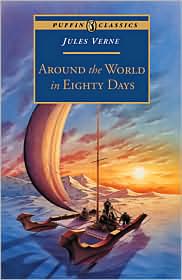
I'm reading two books for the first time right now, for my seventh and eighth grade English classes, and enjoying them thoroughly. They're classics, but in case you never read them either, add them to your summer reading list. Around the World in Eighty Days is a blast. I can't believe I've never read Verne before. The characters are funny, and the plot suspenseful. (O-kay, I read the last few chapters [which is NOT a typical habit] so I'd know what to expect and could properly steer class discussion while we're reading it...but it's still been exciting seeing how it all pans out.)

If you don't know, Phileas Fogg is an methodical, home-loving Englishman from 1872 who takes on a home-loving butler Passepartout, only to tell him he's just taken a bet that he can get around the world in eighty days. The world having just been made that much smaller by the steamboat and train, he sets out to prove this to his whist-playing friends of his Club. So you follow him as he goes -primarily by boat and train- eastward around the world, being chased by a detective, and thoroughly convinced he'll have no trouble winning his two-thousand-pound bet.

It'll be a great cap-off-the-year read with the seventh graders who've been studying geography all year, to plot his journey round the earth.
The Bronze Bow is one of those books I recall my mother telling me several times to read, but I wasn't drawn in by the cover or time period, and I guess a bit stubborn on taking reading suggestions (which I realize is stupid, but I was 13). I've not gotten very far yet, but it's quite engaging.

The setting is Judea during the time of the Romans. The main character Daniel is a zealot, who's living in exile from his home town, hoping he's part of a growing army to throw off the Romans. He knows Simon the Zealot who begins to follow Jesus and tries to show Daniel Him.

We're starting our unit on the Romans in eighth grade next week...

I'm pedalling back and forth between them - getting sucked into one, and then realizing I need to keep up with my English class in the other. So far I've gotten Phileas Fogg into India, but it's really time to turn back to Daniel in Capernaum.

Saturday, May 24, 2008

a waterfall

Two years ago, we went on this hike, to Panther Creek Falls. And I said I wanted to go back. So, a few weeks ago, we did. The water was too cold, and weather too chilly for getting in the water…at least for me.


But when I read this passage by Annie Dillard, I thought about the last time I had gone there, and sat under the waterfall.


"What does it feel like to be alive?


"Living, you stand under a waterfall. You leave the sleeping shore deliberately; you shed your dusty clothes, pick your barefoot way over the high, slippery rocks, hold your breath, choose your footing, and step into the waterfall. The hard water pelts your skull, bands in bits on your shoulders and arms. The strong water dashes down beside you and you feel it along your calves and thighs rising roughly back up, up to the roiling surface, full of bubbles that slide up your skin or break on you at full speed. Can you break there? Here where the force is greatest and only the strength of your neck holds the river out of your face? Yes, you can breathe even here. You could learn to live like this. And you can, if you concentrate, even look out at the peaceful far bank where maples grow straight and their leaves lean down. For a joke you try to raise your arms. What a racket in your ears, what a scattershot pummeling!"


Monday, May 12, 2008

summer is

summer is my jean skirt, which i pulled out today for the first time this season. summer is living in my chacos, which i noticed today are worse for their three years wear. summer is blue skies with puffy clouds overhead as i drive down the highway.

"Summer was on its way; Jem and I awaited it with impatience. Summer was our best season: it was sleeping on the back screened porch in cots, or trying to sleep in the treehouse; summer was everything good to eat; it was a thousand colors in a parched landscape; but most of all, summer was Dill."

- Scout

Monday, April 21, 2008

sentences

I haven't really written in a while. But I like sharing quotes. I'm looking forward to reading Annie Dillard's A Writing Life. But for now, here's a quote from her on writing from An American Childhood.
But like anyone, I could recall and almost see fleet torn fragments of a scene: a raincoat sleeve's wrinkling, a blond head bending, red-lighted rain falling on asphalt, a pesteringly interesting pattern in a cordovan shoe, which rises and floats across the face I want to see. I perceived these sights as scraps that floated like blowing tissue across some hollow interior space, some space at the arching roof of the rib cage, perhaps. I swerved to study them before they slid away.

I hoped that the sentences would nail the blowing scraps down. I hoped that the sentences would store scenes like rolls of film, rolls of film I could simply reel off and watch. But of course, the sentences did not work that way. The sentences suggested scenes to the imagination, which were no sooner repeated than envisioned, and envisioned just as poorly and just as vividly as actual memories.

Saturday, April 19, 2008

you can't test courage cautiously

For Courtney
From An American Childhood


Just this once I wanted a task that would require all the joy I had.... Just this once I wanted to let it rip.Flying rather famously required the extra energy of belief, and this, too, I had in superabundance.


I ran the sidewalk full tilt. I waved my arms ever higher and faster; blood balled in my fingertips. I knew I was foolish. I knew I was too old really to believe in this as a child would, out of ignorance; instead I was experimenting as a scientist would, testing both the thing itself and the limits of my own courage in trying it miserably self-conscious in full view of the whole world. You can't test courage cautiously, so I ran hard and waved my arms hard, happy.

Up ahead I saw a business-suited pedestrian. He was coming stiffly toward me down the walk. Who could ever forget this first test, this stranger, this thin young man appalled? I banished the temptation to straighten up and walk right. He flattened himself against a brick wall as I passed flailing--although I had left him plenty of room. He had refused to meet my exultant eye. He looked away, evidently embarrassed. How surprisingly easy it was to ignore him! What I was letting rip, in fact, was my willingness to look foolish, in his eyes and in my own. Having chosen this foolishness, I was a free being. How could the world ever stop me, how could I betray myself, if I was not afraid?

I was flying. My shoulders loosened, my stride opened, my heart banged the base of my throat. I crossed Carnegie and ran up the block waving my arms. I crossed Lexington and ran up the block waving my arms.

A linen-suited woman in her fifties did meet my exultant eye. She looked exultant herself, seeing me from far up the block. Her face was thin and tanned. We converged. Her warm, intelligent glance said she knew what I was doing --not because she herself had been a child but because she herself took a few loose aerial turns around her apartment every night just for the hell of it, and by day played along with the rest of the world and took the streetcar.

...

I crossed Homewood and ran up the block. The joy multiplied as I ran--I ran never actually quite leaving the ground--and multiplied still as I felt my stride begin to fumble and my knees begin to quiver and stall. The joy multiplied even as I slowed bumping to a walk. I was all but splitting, all but shooting sparks. Blood coursed free inside my lungs and bones, a light-shot stream like air. I couldn't feel the pavement at all.

I was too aware to do this, and had done it anyway. What could touch me now? For what were the people on Penn Avenue to me, or what was I to myself, really, but a witness to any boldness I could muster, or any cowardice if it came to that, any giving up on heaven for the sake of dignity on earth? I had not see a great deal accomplished in the name of dignity, ever.

- Annie Dillard

Monday, April 14, 2008

and another

Some time ago, a friend told this story like it was true:
My sister's friend is a teacher, and at the beginning of the school year she asked her students what they want to be called. One boy said, "Folks call me Bominitious." So, she made a note and proceeded to call him Bominitious for the rest of the school year. Near the end of the year she was having a conference with the student's parents, and she was talking about Bominitious's progress...saying Bomintious this and Bominitious that. And then the parents said, "We don't know who you are talking about. That is not our son." And she looked in her grade book and said, "You're Mr. and Mrs. Jones, right? Daniel Jones's parents?" And they said "Yes, we are." She said, "Well, Daniel asked to be called Bomintious." And they said, "We call him DJ."

Then I read this in An American Childhood (in a particularly hilarious chapter about jokes):
As we children got older, our parents discussed with us every technical, theoretical, and moral aspect of the art. We tinkered with a joke's narrative structure: "Maybe you should begin with the Indians." We polished the wording. There is a Julie Randall story set in Baltimore which we smoothed together for years. How does the lady word the question? Does she say, "How are you called?" No, that is needlessly awkward. She just says, "What's your name?" And he says, "Folks generally call me Bominitious." No, he can just say, "They call me Bominitious."


hmph.

Saturday, April 12, 2008

more from Annie Dillard

Privately I thought the reference librarian at the Homewood Library was soft in the head. The week before, she had handed me, in broad daylight, the book that contained the key to Morse code. Without a word, she watched me copy it, pocket the paper, and leave.

I knew how to keep a code secret, if she didn't. At home I memorized Morse Code promptly, and burned the paper.

Friday, April 11, 2008

i went to the book store

because I wished to buy Annie Dillard's An American Childhood.

I came out of the used bookstore with:
  • An American Childhood
  • The Writing Life (also Annie Dillard)
  • Pilgrim at Tinker Creek (again, Dillard)
  • The Little Prince
  • Wind, Sand and Stars (also Antoine De Saint Exupery)
  • and To Kill a Mockingbird
which believe it or not, I don't own. Now I do.

I am a new fan of Annie Dillard. I love her writing. I first heard of Annie Dillard because one splendid evening last spring, a few of us brought snippets to read aloud to each other at a coffeeshop, and Betsy shared this:
One Sunday afternoon Mother wandered through the kitchen, where Father was making a sandwich and listening to the ball game. The Pirates were playing the New York Giants at Forbes Field. In those days, the Giants had a utility infielder named Wayne Terwilliger. Just as Mother passed through, the radio announcer cried--with undue drama--"Terwilliger bunts one!"

"Terwilliger bunts one?" Mother cried back, stopped short. She turned. "Is that English?"

"The player's name is Terwilliger," Father said. "He bunted."

"That's marvelous," Mother said. "'Terwilliger bunts one.' No wonder you listen to baseball. 'Terwilliger bunts one.'"

For the next seven or eight years, Mother made this surprising string of syllables her own. Testing a microphone, she repeated, "Terwilliger bunts one"; testing a pen or a typewriter, she wrote it. If, as happened surprisingly often in the course of various improvised gags, she pretended to whisper something else in my ear, she actually whispered, "Terwilliger bunts one." Whenever someone used a French phrase, or a Latin one, she answered solemnly, "Terwilliger bunts one."
The whole book An American Childhood is a narrative of her growing up in Pittsburg in the 50s. It's gripping. She paints with words; she writes about life.

more snippets to come.

Friday, April 04, 2008

uncle jack

more from To Kill a Mockingbird

I was proceeding on the dim theory, aside from the innate attraction of such words, that if Atticus discovered that I had picked them up at school he wouldn't make me go.

But at supper that evening when I asked him to pass the damn ham, please, Uncle Jack pointed at me. "See me afterward, young lady," he said.

When supper was over, Uncle Jack when to the livingroom and sat down. He slapped his thighs for me to come sit on his lap. I liked to smell him: he was like a bottle of alcohol and something pleasantly sweet. He pushed back my bangs and looked at me. "You're more like Atticus than your mother," he said. "You're also growing out of your pants a little."

"I reckon they fit all right."

"You like words like damn and hell now, don't you?"

I said I reckoned so.

"Well, I don't," said Uncle Jack, "not unless there's extreme provocation connected with 'em. I'll be here a week, and I don't want to hear any words like that while I'm here. Scout, you'll get in trouble if you go around saying things like that. You do want to grow up to be a lady, don't you?"

I said not particularly.


- chapter 9

Wednesday, March 26, 2008

atticus

When the three of us came to her house, Atticus would sweep off his hat, wave gallantly to her and say, "Good evening, Mrs. Dubose! You look like a picture this evening."

I never heard Atticus say like a picture of what. He would tell her the courthouse news, and would say he hoped with all his heart she'd have a good day tomorrow. He would return his hat to his head, swing me to his shoulders in her very presence, and we would go home in the twilight.

It was times like these when I thought my father, who hated guns and had never been to any wars, was the bravest man who ever lived.


-chapter 11

Tuesday, March 25, 2008

Miss Maudie

"People in their right minds never take pride in their talents."


-to kill a mockingbird.

Thursday, March 20, 2008

folks call me Dill

(for Carol)


"I'm Charles Baker Harris.  I can read. ... I just though you'd like to know I can read.  You got anything needs readin' I can do it..."

"How old are you," asked Jem, "four-and-a-half?"

"Goin' on seven."

"Shoot no wonder, then," said Jem, jerking his thumb at me.  "Scout yonder's been readin' ever since she was born, and she ain't even started to school yet.  You look right puny for goin' on seven."

"I'm little but I'm old."